

Discover "Healing Nations": A Legacy of Global Health
Delve into the extraordinary life, global health work, leadership, and lasting legacy of Dr. Akwo Thompson Ntuba. This compelling book offers an inspiring journey from humble beginnings to significant global impact.

About "Healing Nations"
"Healing Nations" tells the incredible story of Dr. Akwo Thompson Ntuba. It chronicles his life, his dedication to global health, his impactful leadership, and the enduring legacy he built. This book is a profound look at how one individual can make a difference on a global scale.

Who should read this book?
This book is for anyone seeking inspiration and a testament to perseverance. It traces the journey of a young boy born in Kumba who rose to become a medical doctor, political leader, preacher, and politician, profoundly influencing Cameroon, Nigeria, Africa, Europe, and the USA. It's a must-read for those who believe in the power of resilience and ambition.

The core message
After finishing "Healing Nations," we want you to carry one powerful idea: global health is the future. Dr. Ntuba's life work demonstrates the critical importance of interconnected health initiatives and the impact they have on communities worldwide.
"The inspiration to write 'Healing Nations' came from the desire to pass down experiences and resources, offering guidance and motivation through the extraordinary life of Dr. Akwo Thompson Ntuba."
HEALTHNDEVELOPMENT
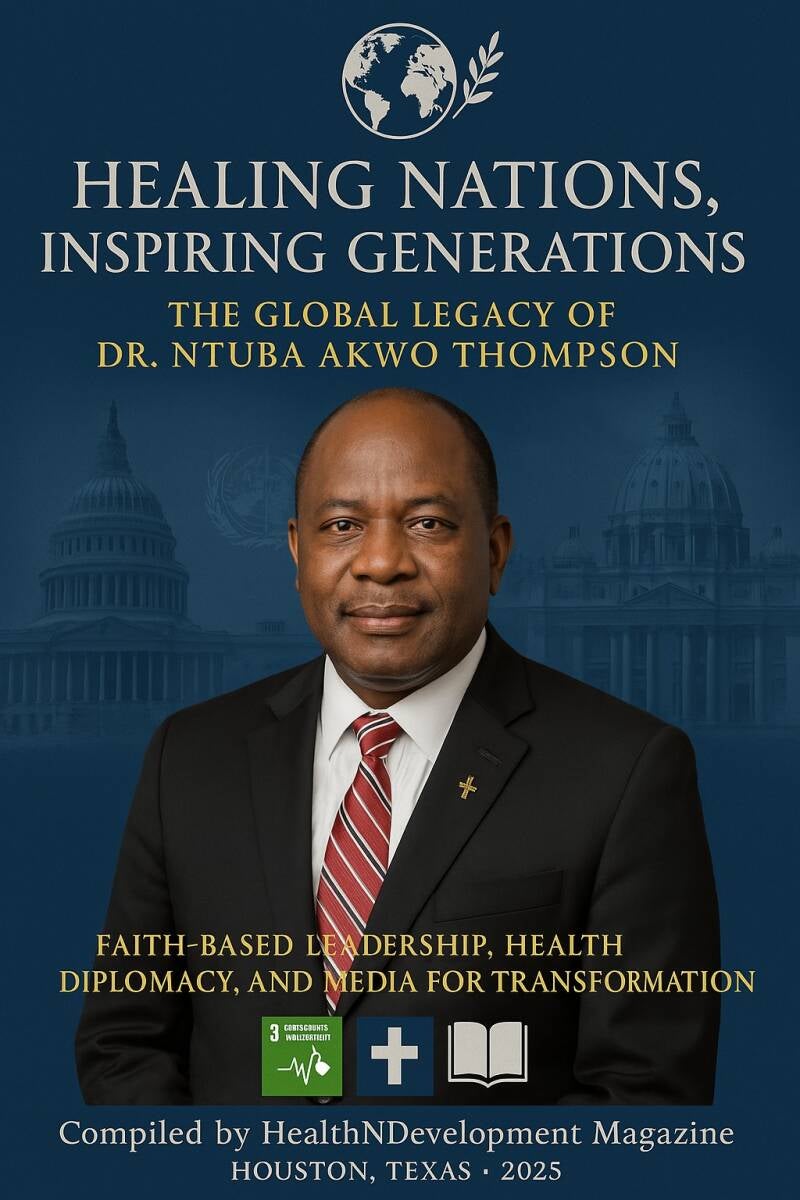
📘 HEALING NATIONS: The Global Legacy of Dr. Akwo Thompson Ntuba
Chapter Contents (Full Book Blueprint)
Faith‑Based Leadership · Global Health · Governance · Communication · 30 Years of Service
PART I — FOUNDATIONS OF A GLOBAL HEALER
Chapter 1 — Origins: The Making of a Physician‑Communicator
-
Early life, calling, and the fusion of faith and medicine
-
First encounters with community health needs
-
The birth of a lifelong mission: healing, teaching, and governance
Chapter 2 — Clinical Beginnings in Cameroon
-
Deputy Chief Medical Officer, St. Francis Polyclinic Kumba
-
Director, Bethel Health Foundation
-
Building clinical systems in resource‑limited settings
-
Early leadership in maternal, neonatal, and child health
Chapter 3 — The Rise of a Governance Leader
-
Founder & Secretary General, Kumba Private Providers Association
-
National Chairman for Health, SWELA
-
Advising the Prime Minister’s Office and the Presidency
-
Youth programming, civic leadership, and political health advocacy
PART II — GLOBAL HEALTH TRAINING THAT SHAPED A CONTINENTAL VOICE
Chapter 4 — Johns Hopkins and USAID: The Global Classroom
-
Why advanced training became essential
-
Overview of all completed programs
-
How global eLearning transformed African health leadership
Chapter 5 — Maternal Health: Protecting Mothers, Strengthening Nations
Courses integrated:
-
Antenatal Care
-
Emergency Obstetric & Newborn Care
-
Postpartum Care & Hemorrhage Prevention
-
Malaria in Pregnancy
-
Healthy Timing & Spacing of Pregnancy
-
Maternal Survival Programming
Impact areas:
-
Reducing maternal mortality
-
Strengthening obstetric systems
-
Integrating HIV prevention into maternal care
Chapter 6 — Neonatal & Child Survival: Saving the First Thousand Days
Courses integrated:
-
Essential Newborn Care
-
Newborn Sepsis
-
Pneumonia & Diarrheal Disease
-
Immunization Essentials
-
Nutrition
-
Emergency Newborn Care
Impact areas:
-
Newborn survival strategies
-
Facility‑based and community‑based interventions
-
Training health workers across regions
Chapter 7 — Family Planning & Reproductive Health: Empowering Women and Youth
Courses integrated:
-
FP101, Counseling, Programming
-
IUD, Hormonal Methods, Standard Days Method
-
FGM/C
-
Youth Sexual & Reproductive Health
-
Logistics for Health Commodities
-
FP for People Living with HIV
Impact areas:
-
Women’s empowerment
-
Youth reproductive‑health education
-
Faith‑based reproductive‑health advocacy
Chapter 8 — HIV/AIDS Leadership Across Continents
Courses integrated:
-
HIV Surveillance
-
M&E for Key Populations
-
HIV/AIDS Legal & Policy Requirements
-
Mother‑to‑Child Transmission of HIV
-
GIS Techniques for HIV Programs
Impact areas:
-
Work in Nigeria, Cameroon, and Europe
-
Scientific exchanges with European and American experts
-
Participation in IAS conferences (Washington, etc.)
-
Fast‑Track Cities work in Houston & San Antonio
PART III — SYSTEMS, GOVERNANCE, AND POLICY
Chapter 9 — Health Governance & Policy: Building Systems That Work
Courses integrated:
-
Governance & Health
-
Good Governance in Medicines
-
Pharmaceutical Systems Strengthening
-
Quality Assurance for Medical Products
-
Infrastructure for Good Governance
Impact areas:
-
Strengthening national health governance
-
Advising leaders on policy and system reforms
-
Ensuring transparency and accountability
Chapter 10 — Health Management & Frameworks: The Architecture of Health Systems
Courses integrated:
-
Impact Analysis
-
Data Quality & Data Use
-
Economic Evaluation
-
Health Workforce Productivity
-
Geographic Approaches to Global Health
-
Health Communication for Managers
-
Social Marketing & Social Franchising
-
Knowledge Management
-
mHealth
-
Online Communities of Practice
Impact areas:
-
Designing and evaluating health systems
-
Leading change in health institutions
-
Using data to drive decisions
Chapter 11 — Monitoring & Evaluation: Measuring What Matters
Courses integrated:
-
M&E Fundamentals
-
Mortality Surveillance
-
DHS Data Use
-
Gender M&E
-
M&E for HIV/AIDS Programs
-
GIS for M&E
-
M&E for Key Populations
Impact areas:
-
Evaluating global health communication programs
-
Strengthening data systems
-
Ensuring program accountability
-
Using M&E to guide policy
PART IV — COMMUNITY, EQUITY, AND ENVIRONMENT
Chapter 12 — Community Health: Healing at the Grassroots
-
Foundations from An Introduction to Community Health
-
High‑school outreach in Kumba
-
Youth leadership in the CPDM
-
Community‑based family planning
-
Faith‑based community mobilization
Chapter 13 — Early Childhood Development: Protecting the Most Vulnerable
Courses integrated:
-
Early Childhood Development
-
Integrated ECD Programming
-
Improving Lives of Vulnerable Children
-
Special Considerations for Highly Vulnerable Children
-
Creating Enabling Environments
-
M&E of Holistic ECD Programs
Impact areas:
-
Child protection
-
Caregiver support
-
Vulnerable‑child programming
Chapter 14 — Environmental Health, Climate, and Resilience
Courses integrated:
-
Climate & Health
-
WASH (Water, Sanitation & Hygiene)
-
Famine Early Warning Systems
-
Population, Health & Environment
Impact areas:
-
Climate‑health advocacy
-
Environmental determinants of health
-
Disaster preparedness and resilience
PART V — FAITH, MEDIA, AND GLOBAL DIPLOMACY
Chapter 15 — Faith‑Based Leadership: Healing Through Ministry
-
Ntuba Ministries International
-
Gospel Ministers Association
-
Integration of faith, healing, and development
-
Work with the All Africa Conference of Churches
-
Geneva‑based global faith networks
Chapter 16 — Media, Communication, and Global Influence
-
Editor‑in‑Chief, HealthNDevelopment Magazine
-
Accredited press at global conferences
-
Producing papers, commentaries, and health communication resources
-
Using media to shape public health narratives
Chapter 17 — Diplomacy, Governance, and International Engagement
-
Work with mayors, governors, lawmakers, and presidents
-
U.S. health‑policy engagement
-
European scientific diplomacy
-
African regional leadership
PART VI — THE LEGACY
Chapter 18 — Healing Nations: A Philosophy of Service
-
The moral framework of global health
-
Faith as a driver of compassion
-
Governance as a tool for justice
-
Communication as a bridge between worlds
Chapter 19 — Inspiring Generations: Mentorship and Leadership Development
-
Youth leadership
-
Training future health workers
-
Building community resilience
-
Creating global health curricula
Chapter 20 — The Road Ahead: A Vision for the Next 30 Years
-
Climate‑health integration
-
Digital health and AI
-
Global governance reforms
-
The future of African and global health systems
**📘 INTRODUCTION
HEALING NATIONS: The Global Legacy of Dr. Akwo Thompson Ntuba**
There are lives that move quietly through the world, touching a few people, leaving a few footprints, and fading gently into memory. And then there are lives like that of Dr. Akwo Thompson Ntuba — lives that cross continents, shape institutions, influence governments, and leave behind a trail of strengthened communities, empowered youth, healed families, and transformed systems.
This book is the story of such a life.
It is the story of a physician who refused to limit himself to the walls of a clinic. A communicator who understood that healing requires not only medicine, but knowledge, governance, faith, and voice. A leader who moved from the villages of Cameroon to the halls of European conferences, to the policy rooms of American cities, carrying with him a mission that never changed: to heal nations by healing people, systems, and the structures that shape their lives.
For nearly three decades, Dr. Ntuba has stood at the intersection of:
-
clinical medicine,
-
global health,
-
governance and policy,
-
faith‑based leadership,
-
youth empowerment,
-
media and communication,
-
and international diplomacy.
His journey is not simply professional — it is spiritual, intellectual, and deeply human.
From the early days in Kumba, where he served as Deputy Chief Medical Officer and later Director of Bethel Health Foundation, to his leadership roles advising the Prime Minister’s Office and the Presidency of Cameroon, to his global training with Johns Hopkins University and USAID, to his work with mayors, county judges, and health‑system leaders in the United States — his life has been a continuous movement toward service.
This book is not a chronological list of achievements. It is a map of impact.
It traces how a young physician became:
-
a continental advocate for maternal and child health,
-
a global voice in HIV/AIDS governance,
-
a policy advisor,
-
a faith‑rooted leader,
-
a mentor to youth,
-
a scholar of health systems,
-
and a communicator whose words have shaped public understanding across nations.
It explores the training that sharpened his vision — the dozens of programs in maternal health, neonatal care, HIV/AIDS, monitoring and evaluation, governance, environmental health, equity, and community health — and shows how he transformed knowledge into action.
It follows his footsteps through:
-
Cameroon, where he built systems and shaped policy
-
Nigeria, where he strengthened HIV/AIDS programs
-
France, where he engaged European and American scientists
-
Geneva, where he connected faith and global health
-
Houston and San Antonio, where he contributed to Fast‑Track Cities and U.S. health governance
-
Washington, D.C., where he served as accredited press and communication expert at International AIDS Society conferences
And it reveals the philosophy that guided him: healing is not only clinical — it is structural, spiritual, and societal.
This book is titled Healing Nations because that is what Dr. Ntuba has spent his life doing — not through speeches alone, not through clinics alone, not through policy alone, but through a rare combination of all three.
This is the story of a man who believed that nations can be healed — and then spent his life proving it.
**📘 CHAPTER ONE
ROOTS OF A HEALER: THE MAKING OF A PHYSICIAN‑COMMUNICATOR**
Every great mission begins long before the world notices it. For Dr. Akwo Thompson Ntuba, the seeds of global service were planted in the soil of community, faith, and responsibility.
A Childhood Shaped by Calling
Growing up in Cameroon, he witnessed firsthand the realities of illness, poverty, and the fragile systems that held communities together. He saw mothers struggle to access care, children weakened by preventable diseases, and families navigating a health system that needed both compassion and reform.
These early experiences did not discourage him — they ignited him.
He felt a calling not only to treat illness, but to understand the structures that allowed illness to persist. Even as a young man, he sensed that healing required more than medicine. It required leadership. It required communication. It required a willingness to stand between communities and the systems that shaped their lives.
The Fusion of Faith and Medicine
Faith was not an accessory in his life — it was a foundation. It taught him that healing is sacred work. It taught him that leadership is service. It taught him that every human being carries dignity, and that health is a moral right, not a privilege.
This spiritual grounding would later shape his ministry, his work with the Gospel Ministers Association, and his engagement with the All Africa Conference of Churches and the World Council of Churches.
Choosing Medicine — and More Than Medicine
When he entered medical training, he did so with a dual vision:
-
To become a clinician capable of saving lives, and
-
To become a communicator capable of shaping systems.
This dual identity — physician and communicator — would define his entire career.
Early Leadership: The First Signs of a Global Mission
Even before his global engagements, Dr. Ntuba showed a natural ability to lead:
-
He organized youth programs.
-
He supported community health initiatives.
-
He built networks among local providers.
-
He engaged civic leaders in health discussions.
These early roles foreshadowed the governance and policy work he would later undertake at national and international levels.
A Mind Drawn to Systems
While many clinicians focus solely on the patient in front of them, Dr. Ntuba’s mind was always drawn to the system behind the patient:
-
Why did mothers arrive late to the clinic?
-
Why were medicines unavailable?
-
Why were youth uninformed about reproductive health?
-
Why did preventable diseases continue to claim lives?
These questions pushed him beyond the boundaries of traditional clinical practice.
They pushed him toward public health, governance, policy, and global systems thinking.
The First Step Toward a Global Path
By the time he completed his early medical work in Cameroon, it was clear that his mission was larger than any single clinic or community.
He was ready for the world — and the world was ready for him.
His next steps would take him into:
-
advanced global‑health training,
-
international conferences,
-
cross‑continental collaborations,
-
and leadership roles that would shape health systems across nations.
This is where the journey truly begins.
PART I — FOUNDATIONS OF A GLOBAL HEALER
Introduction to Part I
Every great legacy begins long before the world recognizes it. Before the conferences, before the global engagements, before the policy rooms and international platforms, there is always a foundation — a place where conviction is shaped, character is tested, and purpose is born.
For Dr. Akwo Thompson Ntuba, the foundations of his global mission were laid in the intimate spaces of community life, faith, and early clinical service. These were the years when he learned that healing is not only a medical act but a moral responsibility; that leadership is not a title but a calling; and that the health of a nation begins with the health of its people.
Part I of this book explores those beginnings.
It traces the emergence of a young physician‑communicator whose worldview was shaped by:
-
the realities of illness and resilience in Cameroon,
-
the spiritual grounding of ministry and service,
-
the early responsibilities of clinical leadership,
-
the awakening to systemic injustice in health,
-
and the first encounters with the power of communication, governance, and community mobilization.
These chapters reveal the roots of a healer — not only the medical training, but the deeper forces that shaped Dr. Ntuba’s identity:
-
the compassion that guided his clinical work,
-
the courage that fueled his advocacy,
-
the curiosity that pushed him toward global health,
-
and the conviction that healing must extend beyond the bedside into the structures that govern society.
This section also introduces the early leadership roles that foreshadowed his future impact: the youth programs he organized, the community health initiatives he supported, the networks he built among private providers, and the civic responsibilities he embraced long before stepping onto the global stage.
Part I is the story of formation — the shaping of a man who would later stand before mayors, governors, lawmakers, and international leaders, carrying with him the lessons learned in the clinics, churches, classrooms, and communities of his early life.
It is the story of how a healer is made.
And it is the beginning of a journey that would one day stretch across continents, touch countless lives, and inspire generations.