

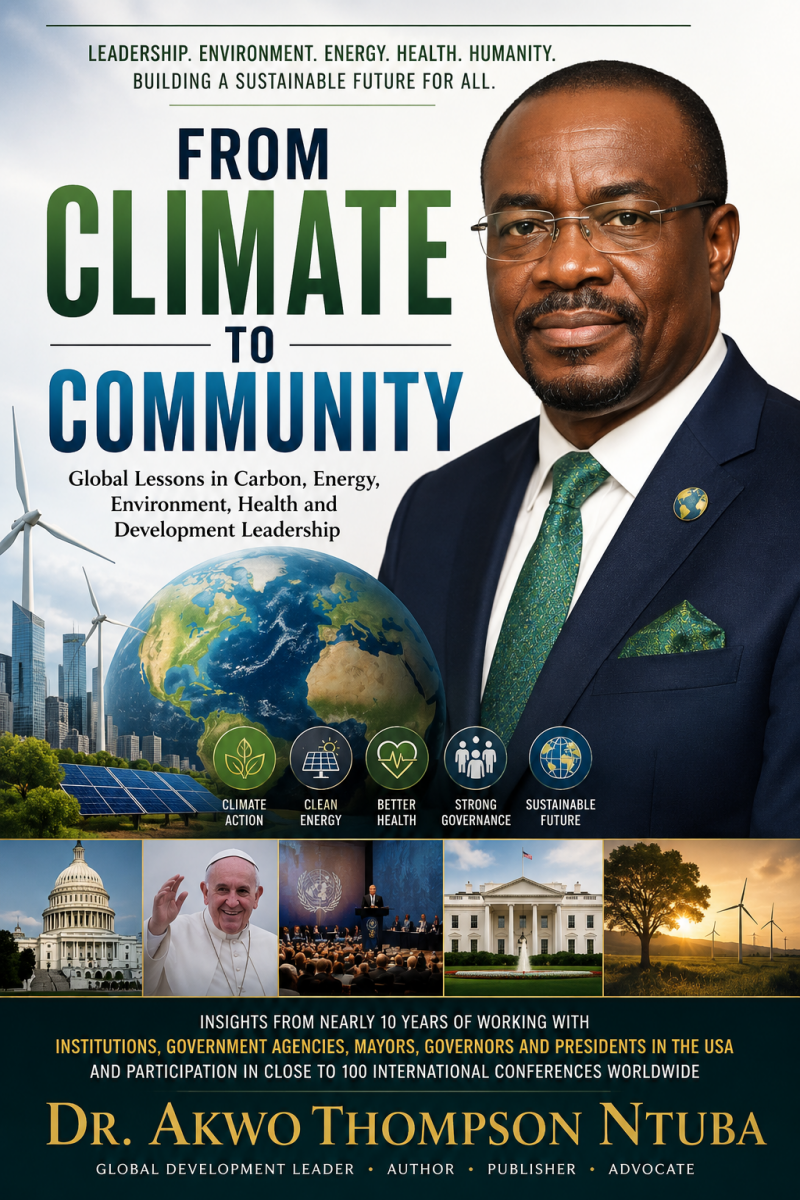
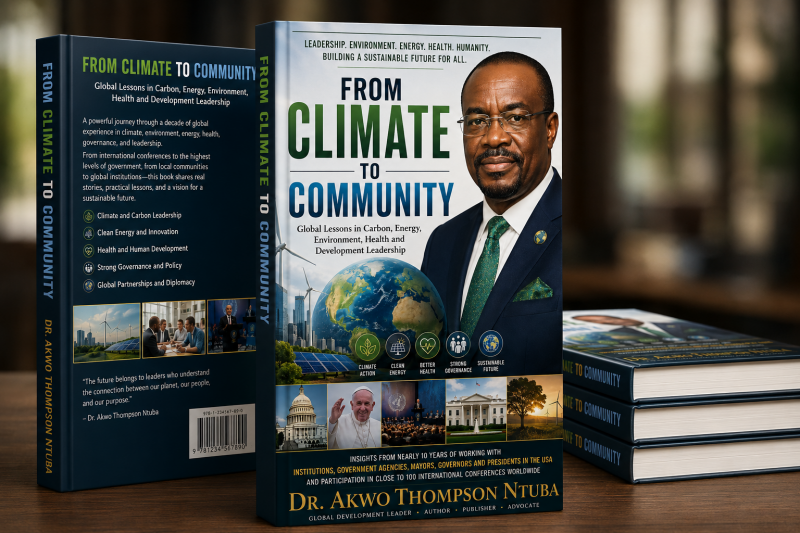
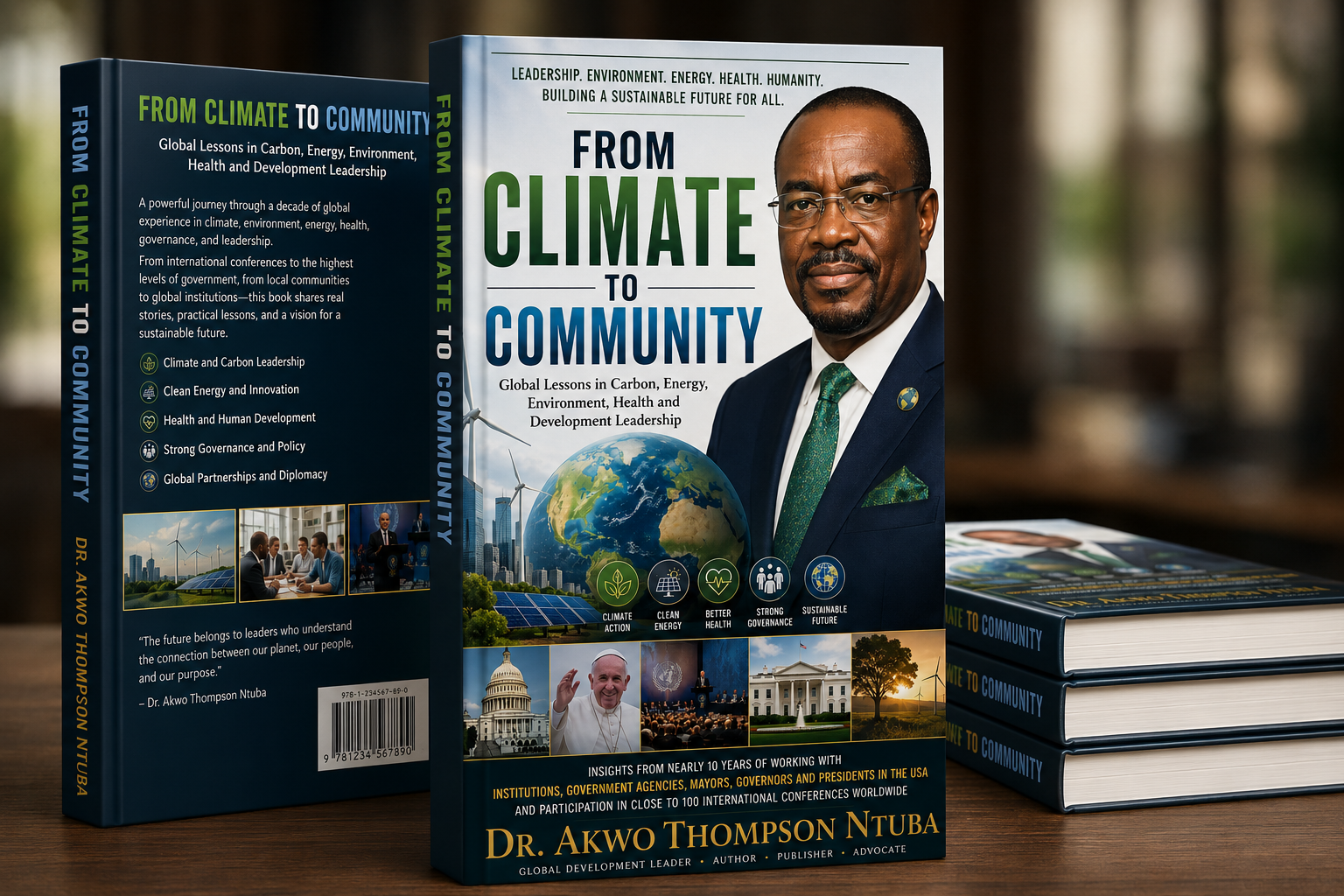
FROM CLIMATE TO COMMUNITY: A decade of insight
Explore a transformative journey from global environmental challenges to local community solutions. Dr. Akwo Thompson's extensive work, research, and leadership converge in this essential reading for a sustainable future.
Unveiling a decade of dedication
Discover DR AKWO THOMPSON'S close to 10 years of dedicated work on carbon, global warming, climate change, energy, environment, and health. This book brings together experiences from working with mayors, governors, presidents, congress people, and activists like Al Gore and Bloomberg. It also draws insights from energy conferences, Earth Day meetings and summits, and collaborations with the World Health Organization and the United Nations. This comprehensive body of work forms the core message of "FROM CLIMATE TO COMMUNITY."

Who will benefit from this essential read?
This powerful book is designed for a broad audience eager to understand and contribute to a healthier planet. Environmentalists will find in-depth analysis and practical approaches. Community leaders will gain strategies for local impact. Students will receive a comprehensive educational resource, and the general public will be empowered with knowledge to make informed decisions about climate and community. "FROM CLIMATE TO COMMUNITY" is a must-read for anyone committed to environmental stewardship and societal well-being.
What makes this book unique?
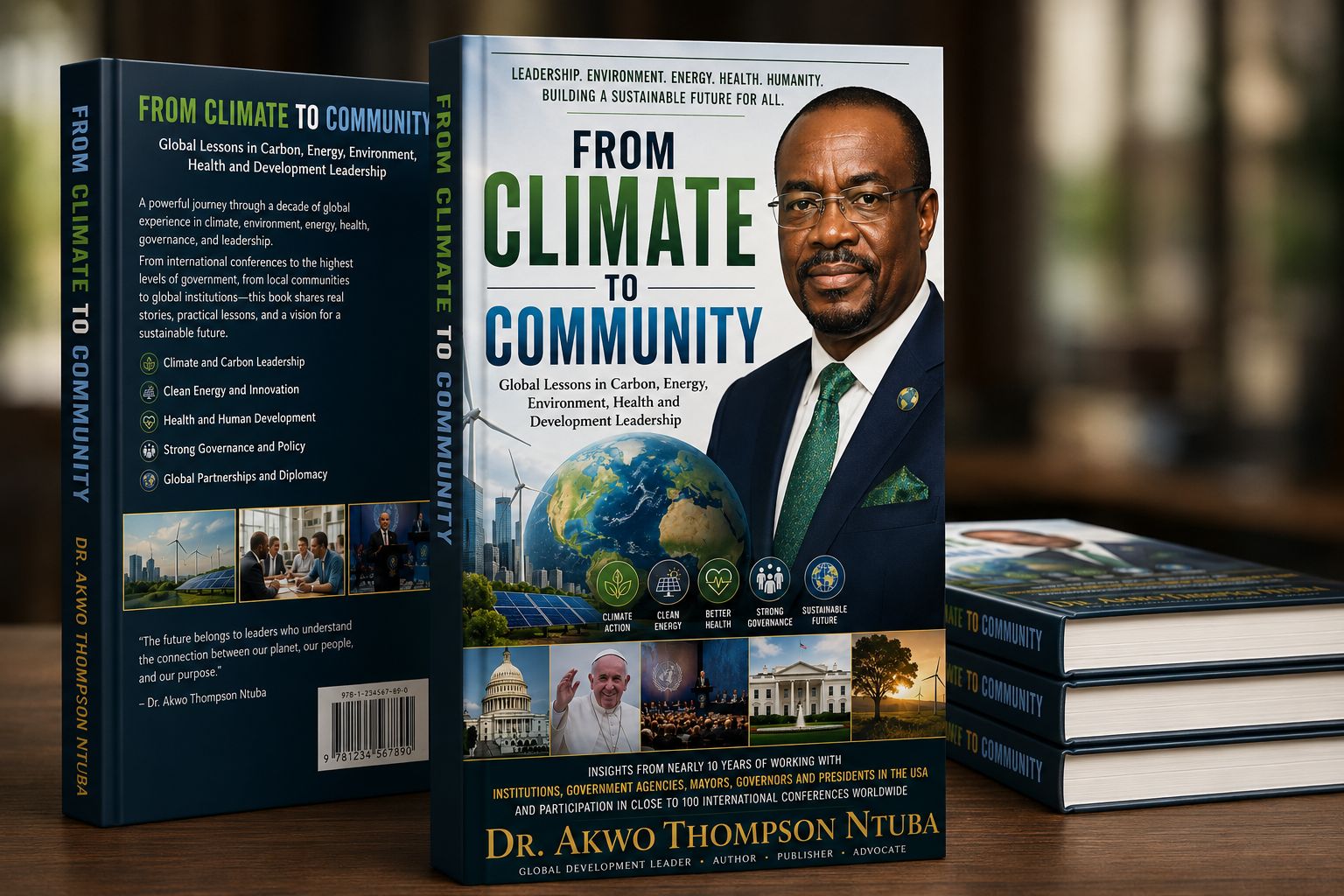
"FROM CLIMATE TO COMMUNITY" stands apart through its exceptional depth of research, invaluable life experiences, and the unparalleled leadership input from Dr. Akwo Thompson Ntuba. The book integrates insights gleaned from numerous energy conferences and interviews with thought leaders, offering a holistic perspective rarely found in other works on similar topics. It's not just a book; it's a testament to years of dedicated work and a beacon of original thought.
Ready to explore?
Delve into the pages of "FROM CLIMATE TO COMMUNITY" and join the conversation that matters. For inquiries, contact us at [[email]] or call [[phonenumber]].
PART I — THE GLOBAL CLIMATE REALITY
Chapter 1: Understanding the Climate Crisis
- What climate change means
- Carbon emissions and global warming
- Environmental degradation and global risks
- Scientific and political debates
- Impact on developed and developing nations
Chapter 2: Carbon and the Future of Humanity
- Carbon economies and industrialization
- Fossil fuels versus renewable energy
- Global carbon policies
- International climate agreements
- Net-zero strategies
Chapter 3: Climate Change and Public Health
- Air pollution and respiratory diseases
- Heat waves and health emergencies
- Climate-related migration
- Food security and malnutrition
- Mental health impacts of environmental crises
PART II — GLOBAL EXPERIENCE AND LEADERSHIP
Chapter 4: Working with American Institutions and Government Agencies
- Experiences with U.S. institutions
- Environmental and health policy frameworks
- Lessons from federal and state agencies
- Public-private partnerships
- Building institutional trust
Chapter 5: Climate Leadership from Mayors, Governors, and Presidents
- Local government responses to climate change
- Urban sustainability initiatives
- National leadership on energy transition
- Political decision-making during crises
- Leadership lessons from public officials
Chapter 6: International Conferences and Global Climate Diplomacy
- Participation in global conferences
- Climate negotiations and diplomacy
- Networking with world leaders and experts
- The role of media and public communication
- Challenges in international cooperation
PART III — ENERGY, DEVELOPMENT, AND AFRICA
Chapter 7: Africa and the Climate Challenge
- Africa’s vulnerability to climate change
- Desertification, floods, and agriculture
- Energy poverty
- Climate justice and equity
- Opportunities for green growth
Chapter 8: Renewable Energy and Sustainable Development
- Solar, wind, hydro, and clean technologies
- Rural electrification
- Economic opportunities in renewable energy
- Green jobs and youth empowerment
- Sustainable infrastructure
Chapter 9: Environmental Governance and Public Accountability
- Government responsibility in environmental protection
- Corruption and environmental exploitation
- Community participation
- Transparency and policy implementation
- Role of civil society
PART IV — HEALTH, MEDIA, AND GLOBAL ADVOCACY
Chapter 10: Health and Development in a Changing Climate
- Public health systems under climate stress
- Pandemic preparedness
- Environmental health policies
- Water and sanitation challenges
- Health equity and vulnerable populations
Chapter 11: Media, Communication, and Climate Awareness
- The role of journalism in climate education
- Building Health and Development Magazine and Media
- Media ethics and public trust
- Communicating science to the public
- Fighting misinformation
Chapter 12: Youth, Education, and the Future
- Preparing future climate leaders
- Environmental education
- Innovation and entrepreneurship
- Youth activism
- Universities and research institutions
PART V — THE FUTURE
Chapter 13: The Green Economy and Global Transformation
- Future industries and technologies
- Artificial intelligence and sustainability
- Global investment in clean energy
- Economic transformation strategies
- International cooperation
Chapter 14: A Vision for Sustainable Nations
- Governance models for the future
- Policy recommendations
- Balancing development and environmental protection
- Inclusive leadership
- Building resilient societies
Chapter 15: Legacy, Leadership, and Humanity
- Reflections on decades of global experience
- Lessons learned from international work
- Moral responsibility toward future generations
- Hope, resilience, and global citizenship
- Final message to world leaders and young people
Introduction / Foundation of the Book
From Climate to Community: Global Lessons in Carbon, Energy, Health, and Humanity
By Dr. Akwo Thompson Ntuba
This book is born out of more than a decade of lived experience, field engagement, and interdisciplinary learning across continents, communities, and crises. It is a reflection of work carried out in Africa, Europe, and the United States—across Nigeria and Cameroon, and through professional and academic engagements in France, Germany, Italy, and the United Kingdom. It is also shaped by direct participation in global climate and energy forums in cities such as Washington, D.C., Houston, and other international hubs where the future of energy, environment, and human survival is actively debated and designed.
At its core, this work is not only about climate change as a scientific or policy issue, but about climate change as a lived human condition. It examines how carbon emissions, energy systems, environmental degradation, and public health outcomes intersect in ways that shape communities, particularly those most vulnerable to environmental stress and economic inequality.
A significant portion of the insights in this book comes from engagements with global climate leaders, policymakers, and institutions. These include participation in climate-focused initiatives linked to former New York City Mayor Michael Bloomberg and his climate and sustainability team in Houston, as well as contributions and attendance at forums involving former Vice President Al Gore, a leading global advocate for climate action. The work also draws from collaboration and learning within the framework of global city networks such as C40 Cities Climate Leadership Group, where urban leaders like former Houston Mayor Sylvester Turner and Congresswoman Sheila Jackson Lee have played important roles in advancing climate resilience and environmental justice.
Beyond policy and leadership dialogues, this book is grounded in real-world environmental reporting and field exposure. It reflects coverage and observation of the devastating human and environmental impacts of climate-related disasters, including hurricanes and tornadoes in cities such as New Orleans and Houston. These events are not presented as isolated natural disasters, but as part of a broader climate reality that exposes gaps in infrastructure, preparedness, and long-term sustainability planning.
A particularly formative experience in shaping this work was time spent in New Orleans in 2025, studying the long-term aftermath of Hurricane Katrina nearly two decades after landfall. This period revealed not only the physical rebuilding of a city, but also the ongoing social, economic, and health disparities that persist in the wake of climate catastrophe. It reinforced the understanding that recovery is not a moment—it is a generational process.
This book also integrates academic and professional development in global environmental health and sustainability practices, including training and engagement with programs associated with Johns Hopkins University, USAID, and environmental initiatives such as the Baobab program focused on environmentalism, mitigation, and community-based resilience strategies.
Ultimately, From Climate to Community is a synthesis of field experience, institutional learning, and human observation. It argues that climate change is not only an environmental challenge but also a health crisis, an economic challenge, and a test of global solidarity. The transition from carbon-intensive systems to sustainable energy futures must also be a transition from fragmented responses to community-centered solutions.
This book is written with the conviction that knowledge must serve action, and that global lessons only become meaningful when they are translated into local change. It is an invitation to policymakers, practitioners, students, and communities to rethink sustainability not as an abstract goal, but as a shared responsibility for human survival and dignity.
Chapter 1
From Climate to Community: Foundations of a Changing World
Why Climate, Energy, Health, and Governance Must Be Understood Together
1.1 A World at a Turning Point
Humanity is living through a defining moment in its history. The world is experiencing rapid environmental transformation driven by rising global temperatures, shifting weather systems, expanding urban populations, and increasing pressure on natural resources. These changes are not isolated scientific observations—they are lived realities affecting food systems, public health, migration, economic stability, and national security.
In many parts of the world, climate change is no longer a distant projection. It is present in extreme heatwaves, intensified hurricanes, prolonged droughts, flooding, and changing disease patterns. It is visible in damaged infrastructure, strained hospitals, disrupted agriculture, and growing social inequality. It is also visible in governance systems that struggle to respond at the speed and scale required.
This book begins from a simple but urgent understanding: climate change is not only an environmental issue. It is a human issue, an economic issue, a governance issue, and above all, a development and survival issue.
1.2 A Personal and Professional Journey Across Continents
The foundation of this work is built on more than a decade of experience across continents—Africa, Europe, and North America. It is shaped by time spent in Nigeria and Cameroon, where the realities of environmental vulnerability are closely tied to livelihoods, agriculture, energy access, and public health systems.
It is also shaped by academic and professional exposure in France, Germany, Italy, and the United Kingdom, where energy transition policies, industrial decarbonization strategies, and environmental governance frameworks offer contrasting but valuable lessons in sustainability planning.
In the United States, engagement in cities such as Washington, D.C., and Houston provided direct access to global conversations on climate leadership, energy systems, and environmental resilience. These experiences revealed a critical truth: while climate change is global in cause, its impacts are intensely local.
Each city, each country, and each community responds differently—but all are connected by the same atmospheric system and the same planetary limits.
1.3 Climate Change as a Global Security and Development Issue
Climate change has moved beyond environmental discourse into the center of global security and development policy. It now influences geopolitical stability, economic competitiveness, migration flows, and national preparedness.
Rising sea levels threaten coastal cities. Heat stress reduces labor productivity. Climate-induced disasters strain military and emergency response systems. Agricultural disruption increases food insecurity and political instability in vulnerable regions.
This convergence of environmental stress and socio-political fragility means that climate change is now inseparable from questions of governance and global order. Countries are no longer asking whether climate change is real—they are asking how quickly they can adapt, how effectively they can mitigate risks, and how equitably they can distribute the costs of transition.
In this context, climate policy is no longer optional. It is foundational to national survival and global stability.
1.4 The Interconnected Systems: Climate, Energy, Health, and Governance
At the heart of this book is a systems-based understanding of the world.
Climate, energy, health, and governance do not operate independently. They form a tightly connected structure:
- Energy systems determine the level of carbon emissions released into the atmosphere.
- Carbon emissions drive climate change and environmental instability.
- Environmental change directly impacts human health through air quality, water security, heat exposure, and disease patterns.
- Health outcomes influence economic productivity, social stability, and development capacity.
- Governance systems determine how effectively societies manage energy transitions, environmental risks, and health crises.
When these systems are misaligned, societies experience fragmentation, inefficiency, and vulnerability. When they are aligned, societies build resilience, innovation capacity, and long-term sustainability.
This interconnected framework is essential for understanding why isolated solutions—whether technological, political, or medical—are insufficient. Climate change cannot be solved in isolation from energy reform. Energy reform cannot succeed without governance reform. Governance reform cannot succeed without health and human development considerations.
1.5 Working with Leaders, Institutions, and Global Networks
This book draws heavily from direct engagement with policymakers, institutions, and global leadership networks working at the intersection of climate and development.
These experiences include participation in climate and energy discussions associated with former New York City Mayor Michael Bloomberg’s climate initiatives, where urban leadership and private-sector collaboration were central themes in addressing emissions reduction and sustainable infrastructure development.
The work also includes exposure to high-level global climate advocacy forums involving former U.S. Vice President Al Gore, whose global campaigns have helped bring climate awareness into mainstream political and public discourse.
A significant dimension of this journey has been engagement with global city networks such as C40 Cities Climate Leadership Group. Within this network, cities such as Houston have become important case studies in climate adaptation, energy transition, and urban resilience.
Working alongside political and civic leaders—including former Houston Mayor Sylvester Turner and Congresswoman Sheila Jackson Lee—highlighted the importance of linking policy ambition with community-level implementation. Leadership at the city level often determines whether climate policies remain theoretical or become transformational.
1.6 Climate in Action: Hurricanes, Tornadoes, and Urban Vulnerability
Beyond conferences and policy discussions, this work is grounded in direct observation of climate impacts in real environments.
In cities such as New Orleans and Houston, hurricanes and tornadoes have revealed the fragile relationship between infrastructure, governance, and environmental risk. These disasters demonstrate that climate change is not only about rising temperatures—it is about system failure under stress.
Flooded neighborhoods, displaced families, disrupted economies, and overwhelmed emergency systems are not abstract data points. They are lived experiences that expose the limits of preparedness and the inequalities embedded in recovery systems.
These events also reveal a deeper truth: climate disasters do not end when the weather clears. They continue in the form of long-term recovery challenges, economic disruption, and public health consequences.
1.7 New Orleans and the Long Shadow of Hurricane Katrina
A particularly formative experience in shaping this book was time spent in New Orleans in 2025, studying the long-term aftermath of Hurricane Katrina nearly two decades after landfall.
What becomes clear in such a study is that Katrina is not only a historical disaster—it is an ongoing process. The recovery is uneven, incomplete, and deeply shaped by social and economic inequality.
Entire communities continue to face housing challenges, infrastructure gaps, healthcare access issues, and economic vulnerability. The storm exposed weaknesses in governance systems, emergency preparedness, and social protection frameworks that are still being addressed today.
This experience reinforced a critical understanding: climate resilience is not a short-term project. It is a generational responsibility.
1.8 Global Health, Training, and Institutional Learning
This work is also informed by structured training and engagement in environmental health and sustainability programs, including academic and professional exposure linked to Johns Hopkins University and USAID.
These programs provided technical and policy-oriented frameworks for understanding environmental health risks, disaster preparedness, and community-based resilience strategies. They emphasized that environmental challenges must be addressed through integrated systems of science, governance, and community participation.
Engagement with environmental initiatives such as the Baobab program further reinforced the importance of local knowledge, grassroots participation, and adaptive strategies in addressing climate and health challenges.
1.9 Toward a New Vision of Sustainable Development
The central vision of this book is that sustainable development must be redefined for a changing world.
Sustainability cannot be reduced to carbon targets alone. It must include health equity, governance integrity, energy access, economic opportunity, and environmental justice. It must also recognize that communities are not passive recipients of policy—they are active participants in shaping resilience.
A sustainable future requires:
- Integrated energy transitions that reduce emissions while ensuring access and affordability
- Health systems capable of responding to climate-driven risks
- Governance structures that are transparent, responsive, and adaptive
- Cities and communities designed for resilience rather than vulnerability
- Global cooperation grounded in shared responsibility
1.10 Conclusion: From Knowledge to Action
This chapter has established the foundation for a broader exploration of climate, energy, health, and governance as interconnected systems shaping the future of humanity.
The purpose of this book is not only to document experiences, but to translate them into insight and action. Knowledge without implementation is incomplete. Observation without response is insufficient. Analysis without commitment is ineffective.
From Climate to Community is therefore an invitation—to rethink systems, to reimagine governance, and to rebuild the relationship between humanity and the environment in a way that ensures survival, dignity, and shared prosperity.
The journey ahead is not simple. But it is necessary.