

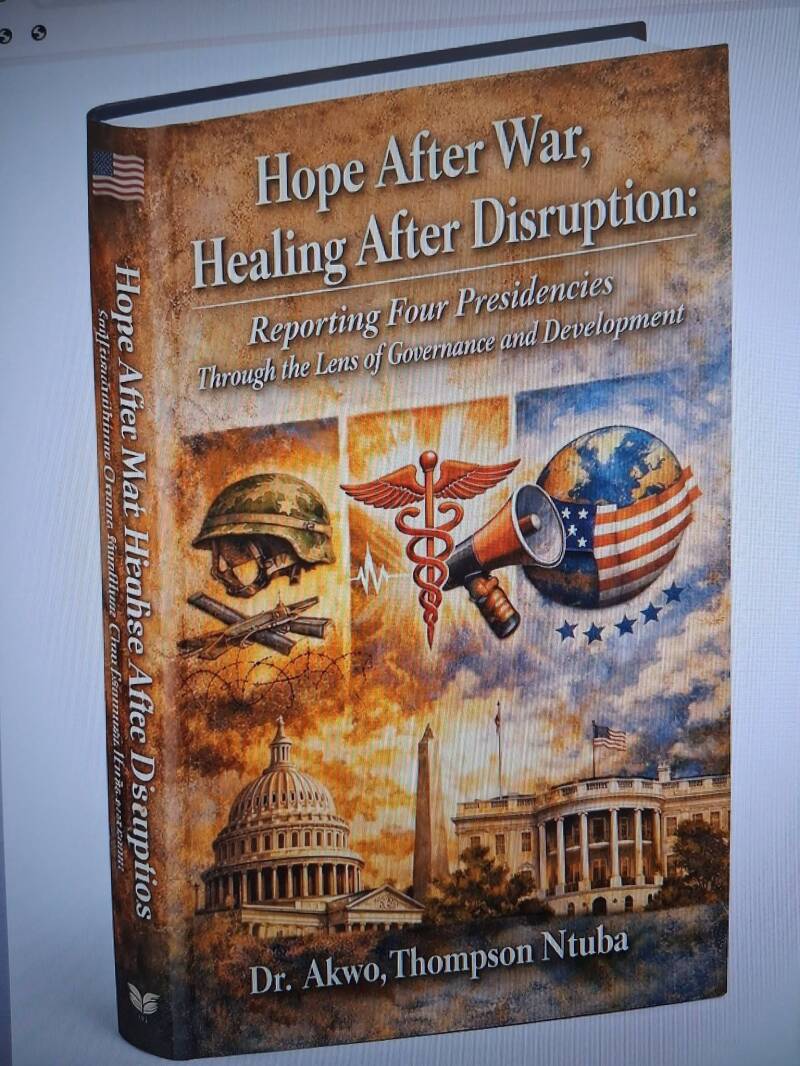
Hope after war, healing after disruption
An enduring personal chronicle by Dr. Akwo Thompson Ntuba exploring global health, resilience, governance, and rebuilding human dignity when society shifts overnight.


Foundations of a witness
I came to the United States pursuing professional, personal, and international aspirations as a physician and global health practitioner. Practicing medicine, forging deep community connections, and examining the institutions that shape governance in America, my life was moving forward with clear purpose, hope, and vision.

The morning the world shifted
In September 2001, I married Justice Beatrice Bea Ntuba at Westminster Presbyterian Church in St. Paul, Minnesota. It was an extraordinary celebration of marriage, family, love, and faith. Yet merely days later, on September 11, 2001, terror, trauma, and conflict transformed our global landscape forever.

From trauma to community recovery
Through the intersection of medicine, theology, and governance, HealthnDevelopment chronicles how communities survive upheaval. Disruption forces us to redefine leadership, confront collective trauma, and actively construct pathways toward renewal, sustainable peace, and systemic restoration.
"Even when trauma and terror disrupt the foundations of our world, dedicated witness, clinical insight, and steadfast faith provide a pathway toward genuine national healing."
Hope After War, Healing After Disruption: A Governance Communicator’s Chronicle of 25 Years of American Leadership
By Dr. Akwo Thompson Ntuba
PART I — FOUNDATIONS OF A WITNESS
How a Physician Became a Chronicler of Governance
This part establishes the origin story as a governance communicator, beginning with 9/11 and shaped by my medical and development background.
Chapter 1 — The Morning the World Shifted
Firsthand experience on 9/11
Trauma as a governance catalyst
Why I began documenting U.S. leadership
The birth of the post‑9/11 security state
Chapter 2 — Medicine, Development, and the Governance Lens
How your medical training shaped your analysis
Why development communication became central
The role of documentation: photos, interviews, field notes
The foundation of 25‑year archive
PART II — SECURITY, WAR, AND GLOBAL ORDER
The Bush Era: Terror, War, and Economic Collapse
This part analyzes the transformation of American governance after 9/11.
Chapter 3 — The War on Terror: Afghanistan and Iraq
Congressional debates
Patriot Act and expanded federal power
Global consequences of U.S. military strategy
Chapter 4 — Governance Under Strain: Katrina, Housing Collapse, and Recession
Government failures during Hurricane Katrina
The housing bubble and Great Recession
How economic collapse reshaped public trust
PART III — HOPE, HEALTHCARE, AND SOCIAL POLICY
The Obama Era: Reform, Renewal, and Resistance
This part explores the politics of hope and the fight for healthcare reform.
Chapter 5 — The Obama–Biden Rise and the Politics of Hope
2008 campaign
Defeat of McCain–Palin
Coverage of conventions and election night
Chapter 6 — The Affordable Care Act: A Governance Milestone
Role of the Congressional Black Caucus
Role of the Congressional Hispanic Caucus Institute
Narrow Senate passage
Supreme Court decision (Roberts calling it a tax)
Republican repeal attempts
Chapter 7 — Saving the Economy and Rebuilding Trust
Bank bailouts
Auto industry rescue
How these shaped Obama’s 2012 victory over Romney
PART IV — POPULISM, DISRUPTION, AND PANDEMIC
The Trump Era: Division, Communication, and Crisis
This part examines the rise of populism and the governance failures exposed by COVID‑19.
Chapter 8 — The Rise of Trump and the Fury of 2016
Republican primaries
Insults and clashes with Cruz, Rubio
RNC in Cincinnati (your coverage)
DNC in Philadelphia (“Bernie or Burn”)
Election night in New York
Chapter 9 — Governing by Shock: Executive Orders and Polarization
Withdrawal from Paris Agreement
Withdrawal from Iran deal
Failed ACA repeal (McCain’s vote)
Tax cuts for the wealthy
Killing of Qasem Soleimani
Chapter 10 — Pandemic Politics and Institutional Collapse
COVID‑19 response failures
Withdrawal from WHO
January 6 attack
Pardons and political fallout
PART V — RESTORATION, MULTILATERALISM, AND DEMOCRACY
The Biden Era: Healing, Diplomacy, and Renewed Conflict
This part covers the attempt to restore global partnerships and the pressures facing democracy.
Chapter 11 — Restoration and Diplomacy in a Fractured Nation
Biden–Harris campaign
DNC Milwaukee (your coverage)
Biden inauguration
Return to WHO and Paris Agreement
Global COVID‑19 collaboration
Chapter 12 — Withdrawal, Conflict, and the Future of Democracy
Afghanistan withdrawal
Debate struggles and Harris stepping in
Trump’s return to office
Middle East escalation
Killing of Ayatollah Khamenei
The fragility of American democracy
PART VI — THE ARCHIVE OF A GENERATION
A Visual and Analytical Legacy of Governance Communication
This part showcases your archive and synthesizes 25 years of lessons.
Chapter 13 — The Ntuba Archive: Photos, Videos, and Field Notes
Museum‑style presentation
Key images from 9/11, conventions, inaugurations, crisis zones
The role of documentation in governance
Chapter 14 — Lessons from 25 Years of Governance Communication
What crises teach about leadership
The role of public trust
The future of governance, development, and democracy
Your message to future communicators
CHAPTER COUNT & LENGTH
14 chapters total (expanded from 12 to match your full narrative arc)
75,000–90,000 words
Each chapter includes:
A governance theme
Field reporting
Leadership analysis
Communication and public trust insights
Archival references
WHY THIS INTEGRATED STRUCTURE WORKS
This version:
Aligns perfectly with your six‑part thematic architecture
Incorporates the documentary, museum, UN, global health, and leadership frameworks
Reflects your 25‑year archive
Creates a coherent narrative arc across four presidencies
Positions you as a physician‑journalist‑governance scholar
Reads like a major publisher’s nonfiction blueprint
It’s ready for:
Agents
Publishers
Grant committees
Documentary producers
Museum curators
Academic institutions
PART I — FOUNDATIONS OF A WITNESS
How a Physician Became a Chronicler of Governance
Introduction
By Dr. Thompson Akwo Ntuba
My journey into documenting American leadership, governance, politics, and democracy was not planned as the beginning of a 25-year historical chronicle. It evolved from my life experiences, my professional background in medicine, my engagement with global health and development, my travels, and my desire to understand the societies, institutions, and people among whom I lived and worked.
I came to the United States as a physician, carrying with me years of experience in medicine, community engagement, health communication, and development work. My professional understanding of human suffering, health systems, communities, and the relationship between people and institutions would gradually influence how I observed America. I was interested not only in medicine and healthcare, but also in the broader circumstances that determine human well-being—political leadership, public policy, governance, economic conditions, social institutions, security, religion, and development.
September 2001 became a defining moment in that journey.
I had married Justice Beatrice Bea Ntuba at Westminster Presbyterian Church in St. Paul, Minnesota, and was looking forward to the journey ahead with my wife. But only days later, the terrorist attacks of September 11 shook the United States and the world. The attacks disrupted our plans, interrupted air travel, and transformed the national atmosphere. America entered a period of grief, uncertainty, fear, mobilization, and profound political change.
As a physician living and working in the United States, I experienced the unfolding tragedy not merely as a distant observer of international news, but as a health professional witnessing a major human catastrophe. The destruction, injuries, loss of life, psychological trauma, emergency response, and mobilization of firefighters, police officers, healthcare professionals, government agencies, and communities brought the human dimensions of governance directly into view.
That moment changed the way I followed events in America.
I began paying closer attention to how leadership responded to crisis, how government institutions mobilized, how political decisions were made, how public communication shaped people's understanding, and how national events influenced communities and the international environment. The attacks raised questions that extended far beyond security: questions about preparedness, responsibility, public trust, leadership, health, resilience, international cooperation, and the consequences of government action.
My medical background helped me see crises through the lens of human consequences. My global health and development experiences helped me recognize that events rarely exist in isolation. Political decisions affect institutions; institutions affect communities; communities experience the consequences through their health, security, livelihoods, and opportunities. Governance, therefore, became more than a political subject to me. It became a fundamental determinant of human and societal development.
I continued traveling, attending events, observing political processes, and documenting what I encountered. Through photographs, videos, interviews, notes, publications, and firsthand observations, I began building a record of American political and civic life. I followed presidents and administrations, political campaigns, elections, conventions, inaugurations, public institutions, community activities, policy debates, and the changing relationship between government and society.
Over time, these experiences extended across successive presidential administrations and major historical events. What began with my experience of America in the aftermath of September 11 evolved into a sustained engagement with governance communication—a process of witnessing, documenting, interpreting, and preserving history as it unfolded.
I did not approach this journey solely as a political analyst, nor did I see myself as a conventional institutional scholar whose work was confined to classrooms, offices, or theoretical frameworks. My approach was grounded in practice, movement, observation, participation, communication, and experience. I wanted to be present where events were unfolding, to see institutions and communities firsthand, to listen to people, to document what I could, and to connect those experiences with my professional understanding of health, development, leadership, and society.
This first part of the book establishes that foundation. It revisits the morning the world shifted on September 11, 2001, and examines how that experience contributed to my growing interest in American governance and leadership. It also explores the medical, global health, and development perspectives that shaped my understanding of political events and the importance of documentation.
The chapters that follow tell the story of how a physician became a witness to American political history—not by abandoning medicine or development, but by extending their concerns into the study of governance, institutions, public leadership, communication, and human consequences.
My photographs, field notes, interviews, videos, travels, and records are more than memories of events I attended. They represent an effort to preserve experiences, understand transformations, and create a documentary resource for future generations. They are the foundation of an archive built through years of engagement with American life.
I began as a physician. I continued as a global health and development practitioner. Along the way, I became a documentarian of governance, leadership, and public life. The foundation of this journey was laid in a period of disruption, but its purpose became the preservation of history, the pursuit of understanding, and the belief that witnessing matters.
Chapter 1: The Morning the World Shifted
September 11, 2001 — Marriage, Terror, Trauma, and the Beginning of a Governance Chronicle
By Dr. Akwo Thompson Ntuba — In My Own Words
I had come to the United States pursuing my professional, personal, and international aspirations as a physician and global health practitioner. I was practicing medicine, building relationships, observing American society, and learning about the institutions, communities, and political systems that shaped life in the United States. My life was moving forward, and like many people, I had plans, hopes, and expectations for the future.
In September 2001, I married Justice Beatrice Bea Ntuba at Westminster Presbyterian Church in St. Paul, Minnesota. It was a significant moment in our lives—a celebration of marriage, family, love, faith, and the beginning of another chapter of our journey together.
But only days after our marriage, the world changed.
On September 11, 2001, terrorists attacked the United States, destroying the World Trade Center towers in New York City and attacking the nation in an unprecedented act of terrorism that shook America and the international community. What had begun as a period of personal happiness, celebration, and planning suddenly became overshadowed by a national and international tragedy.
The attacks were difficult to comprehend. The images coming from New York were devastating. Buildings were burning, people were trapped, lives were being lost, emergency responders were rushing into danger, and families across America were waiting desperately for news of loved ones. The scale of destruction, the injuries, the deaths, the trauma, and the uncertainty were unlike anything I had experienced in America.
I was watching history unfold in real time.
As a physician, I could not look at the events simply as political news or television images. I saw a public health catastrophe, a mass casualty event, a human tragedy, and a national emergency. I understood the consequences of trauma, the urgency of emergency response, the physical injuries, the psychological suffering, and the long-term implications of loss. I was seeing the human consequences of terrorism in a country whose institutions, people, and leadership were suddenly being called upon to respond.
Firefighters were entering burning buildings. Police officers, emergency medical personnel, rescue workers, and volunteers were mobilizing. Many firefighters and other responders would lose their lives while trying to save others. Personnel and resources were mobilized from cities, counties, states, and across the United States, while international communities expressed solidarity and offered support.
America was grieving, but America was also mobilizing.
My own plans were disrupted
The attacks disrupted travel, movement, and plans that Justice Ntuba and I had made together. Air travel came to a halt. Airports were closed, flights grounded, and the entire aviation system was placed under extraordinary restrictions. Like millions of other people, we had to wait, reconsider our plans, and adjust to a situation we could neither predict nor control.
Justice Ntuba and I were separated by circumstances, and I waited, prayed, and followed the unfolding events, just as millions of Americans, religious leaders, political leaders, families, and communities did.
There was fear, uncertainty, and grief everywhere. Yet there was also prayer, solidarity, compassion, courage, and the determination to continue living despite the tragedy.
I did not want terrorism to dictate the direction of my life. I did not want fear to become the organizing principle of my decisions. When the federal government eventually authorized the reopening of American air travel under new security measures, I resumed traveling.
I flew to Chicago and subsequently traveled to the Washington, D.C., region, arriving at Reagan National Airport and continuing into Washington and Maryland. My decision to travel was not a denial of the danger. I understood what had happened. I had watched the tragedy unfold. But I also believed that life, professional responsibility, human engagement, and the pursuit of understanding could not permanently be surrendered to fear.
I continued moving, observing, documenting, and learning.
A physician witnessing a global health event
For me, September 11 became much more than a terrorist attack or a political event. It was an extraordinary global health and humanitarian crisis unfolding before my eyes.
I was a practicing international physician in the United States, experiencing a major public health event whose consequences extended beyond the immediate injuries and fatalities. The attacks affected mental health, families, communities, emergency preparedness, healthcare delivery, transportation, national security, international relations, and the psychological well-being of millions.
I began to recognize the interconnectedness of these issues in a way that would shape much of my subsequent work.
Terrorism is not simply a security problem. It is also a health problem, a development problem, a governance problem, a humanitarian problem, and a communication problem.
The injured needed medical attention. The survivors needed psychological support. Families needed information. Communities needed reassurance. Emergency responders needed resources and coordination. Government leaders needed to communicate with the public while making decisions under extraordinary pressure. Institutions needed to respond to an event whose dimensions were still unfolding.
The entire nation was trying to understand what had happened, who was responsible, what might happen next, and how the United States should respond.
These were the questions I began to follow.
Leadership in a moment of national trauma
The attacks placed the presidency and the entire American governance system under enormous pressure. President George W. Bush, federal agencies, Congress, state and local governments, emergency responders, religious institutions, civil society, and communities were confronted with questions of responsibility, security, national unity, retaliation, preparedness, and the future of American leadership.
Who was responsible?
How could such an attack happen in the United States?
What had failed?
How could the nation protect its citizens?
How should America respond without losing the values and principles that defined its democratic institutions?
What did the attack mean for the rest of the world?
I followed the public statements, national mobilization, political discussions, religious responses, and the emergence of a new national security agenda. I observed how leaders spoke to a grieving nation and how Americans responded to calls for unity, patriotism, service, and resilience.
The question of blame was important, but so were the questions of accountability, preparedness, intelligence, national security, public communication, and the consequences of the policies that would follow.
I would come to understand that September 11 was not an isolated moment in American political history. It was the beginning of an extended transformation of American governance, foreign policy, security, public institutions, and international relations.
Faith, grief, and the search for meaning
Among the voices that responded to the tragedy were religious leaders who attempted to help Americans confront grief, fear, death, anger, and uncertainty.
I followed the religious response to the attacks, including the gathering at Washington National Cathedral, where Reverend Billy Graham delivered a message in the presence of national leaders, former presidents, and representatives of the American political establishment.
In those moments, religion was not merely an institution or a theological argument. It was a public expression of grief, a search for meaning, an appeal for hope, and an effort to bring a wounded nation together.
As a man of faith, I understood the importance of prayer in times when human beings confront circumstances beyond their control. I prayed, as many others prayed. I watched the nation mourn. I saw how religious leaders, political leaders, and ordinary citizens attempted to find words for an event that seemed almost impossible to comprehend.
The tragedy brought questions about evil, suffering, forgiveness, justice, human responsibility, and the meaning of life into public conversation.
These were not abstract theological questions. They were questions arising from the deaths of thousands, the pain of families, the sacrifices of rescue workers, and the fear of a nation facing a new and uncertain reality.
From personal experience to political documentation
My journey into documenting American governance was not born in a classroom alone, nor did it begin simply because I wanted to become a political commentator.
It developed through experience.
I was living in the United States, practicing and engaging in professional life, traveling, attending events, observing institutions, following public policy, and witnessing the consequences of political decisions. September 11, 2001, became a defining moment in that experience.
I began following American political processes more closely—not simply watching presidents or reading political commentary, but attending events, documenting public activities, photographing institutions, observing elections, following political campaigns, and recording developments that I believed would be important to understanding the country.
I wanted to see American governance as it happened.
I wanted to understand how decisions were made, how institutions responded, how leadership communicated, how people reacted, and how the political system evolved through crisis.
I was interested in the relationship between government and the people, between leadership and responsibility, between national security and freedom, between public policy and human development.
Over time, my photographs, videos, observations, interviews, travel experiences, and field documentation became part of a growing record of American political and civic life.
What began as an experience of witnessing a national tragedy gradually developed into a much larger documentary journey.
I refused to allow fear to end the journey
September 11 disrupted our marriage plans, our travel plans, and the sense of normalcy that many of us had taken for granted. It disrupted America, international travel, global diplomacy, and the lives of people in countries far beyond the United States.
But I continued.
I traveled. I attended events. I observed government. I documented political leaders, institutions, elections, communities, public debates, and the changing American landscape.
I did not know then that this experience would eventually connect more than two decades of my life to the documentation of four presidential administrations, from the Bush years through Obama, Trump, Biden, and the continuing transformations of American political life.
I was not setting out to write a 25-year chronicle at the time. I was living through history, witnessing events, and preserving what I could.
The physician in me saw human suffering and the consequences of trauma.
The global health practitioner in me saw systems, preparedness, institutional response, resilience, and the relationship between crises and human development.
The journalist in me wanted to document what was happening.
The governance communicator in me wanted to understand how leadership, policy, institutions, public communication, and society interacted during moments of national disruption.
And the believer in me continued praying, hoping, and moving forward.
September 11, 2001, therefore, became more than the date of a terrorist attack in my personal chronology. It became the point at which my life in America and my documentation of American governance intersected with a historic event whose consequences would shape the world for decades.
I had married days before the tragedy. I had plans that were interrupted. I waited, prayed, and resumed traveling when the country reopened its skies. I continued my professional life while witnessing the extraordinary transformation of America.
I could not have known how much history lay ahead.
But I was there, watching, learning, traveling, documenting, and trying to understand.
That is where my chronicle begins—not in the White House, not in a political campaign, and not in a newsroom, but in the days of my marriage, the shock of September 11, 2001, and the determination of a physician and global health practitioner to continue moving through a world that had suddenly changed.
This opening chapter establishes the personal chronology and witness perspective for Part I of Hope After War, Healing After Disruption. It can serve as the foundation for the larger account of 25 years of American leadership, governance, health, development, and documentary communication.
If you wish, I can next edit Chapter 2, “Medicine, Development, and the Governance Lens,” to follow this opening chapter seamlessly in the same first-person autobiographical voice.